Welcome to the Property World Cup.
With the 2010 FIFA Soccer World Cup being just around the corner, I thought I present something special to YOU. The information I put together over the last couple of weeks is really cool, as well as informative, useful, surprising and FUN!
For those who have no idea what I’m talking about, I’ll explain. From the 11th of June till the 12th of July is held the biggest sports event of the year in South Africa, the 2010 FIFA Soccer World Cup. 32 national teams from around the globe compete against each other to win the trophy.
That’s pretty much the most important bit for you.
What is the “Property World Cup”?
I was interested how other countries from different continents, with different political systems and economical conditions would perform against Australia in regards to property (property prices, attractiveness for investors etc.)
I tried to put the information together as simple and visual as possible. The groups I will present over the next couple of weeks are the real groups, played in the World Cup.
Where did you get the information from?
Most of the information I got from a website,
called www.globalpropertyguide.com. The website gives you a great overview of each country’s property performance.
Now, let’s have look at the first group, Group A - click the pic!

A friend of mine lost a $50 bet on a TV football play. He lost another $50 on the instant replay. Haha :)
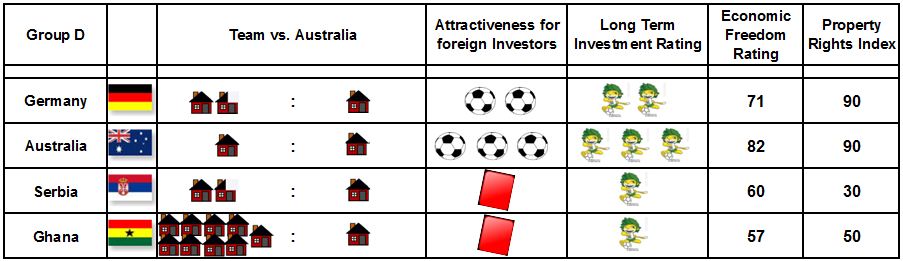
How do I read the table?
Short version:
- the more houses a country has got, the cheaper the average property price
- the more balls, points and mascots, the more attractive is it for foreigners
Extended version
The header of each column tells you what it is about.
- Team vs. Australia – the first team in the table is South Africa. The average price for a property in Australia is $450,000 (at the time of the research). The same amount can buy you on average 1.5 properties in South Africa. Which means, on average, properties in South Africa are cheaper by 33%. Please understand, this is just a guide and very general!!!
- Attractiveness for foreign Investors – 1 ball = don’t touch it!
5 balls = very attractive
- Long Term Investment rating – 1 Zakumi (mascot) = run away!
5 Zakumis = great
• Economic Freedom Rating - Scores are from 0 to 100, higher scores are more desirable i.e. more conducive to economic growth. The lower the score, the greater the level of government interference in the economy and the less economic freedom a country enjoys.
Free 80 - 100; Mostly Free 70 - 79.9; Moderately Free 60 - 69.9;
Mostly Unfree 50 to 59.9; and Repressed 0 - 49.9
• Property Rights Index - A subcomponent of the Index of Economic Freedom, the property rights index measures the degree to which a country’s laws protect private property rights, and the degree to which its government enforces those laws. Higher scores are more desirable, i.e. property rights are better protected. Scores are from 0 to 100. The index also assesses the likelihood that private property will be expropriated and analyzes the independence of the judiciary, the existence of corruption within the judiciary, and the ability of individuals and businesses to enforce contracts. I consider protection of property rights as a significant factor affecting the desirability of a residential real estate investment

I know how you're feeling now!?
I hope that helps. If some explanations need further clarification, please feel free to contact me!
So, did you like it? I can tell you already, this group is a pretty ordinary group. I promise, there are more surprises to come over the next four weeks! Don't go too far, otherwise you end up "off-site"!!! (it meant to be a joke)
And of course, the disclaimer: the information provided are not suitable to make any buying decisions.
If you have any questions or want more information in regards to property in Australia, please feel free to contact me on my mobile phone or via e-mail! I look forward to hear from you!



 Posts
Posts